
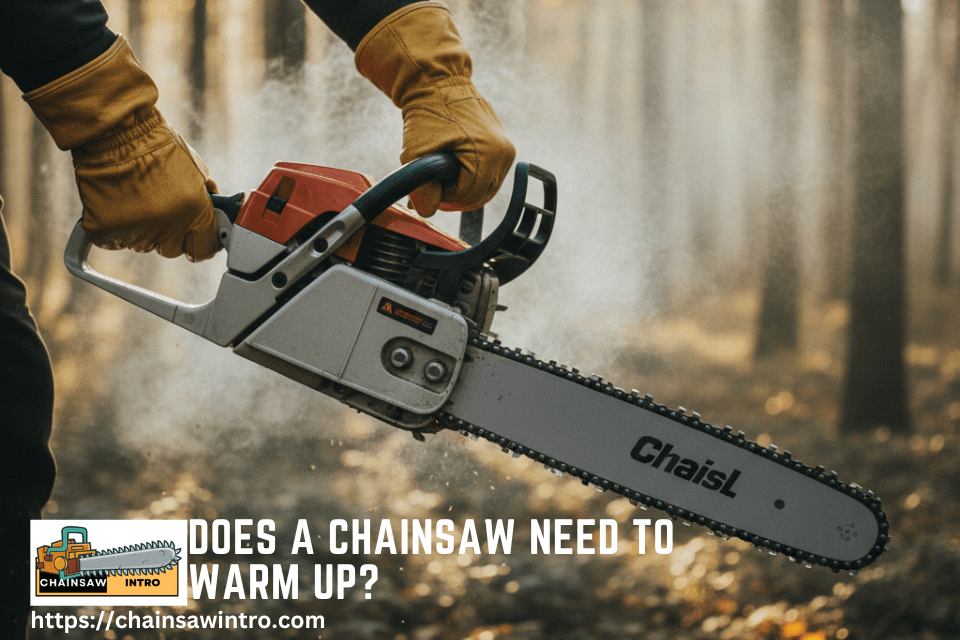

You’ve got a pile of logs to split, a tree to drop, or a fence line to clear — and the last thing you want to do is stand around waiting for your chainsaw to wake up. So you pull the cord, hear that familiar roar, and immediately go to work. Fast, efficient, job done.
Except — are you quietly damaging your engine every single time you do that?
The question of whether chainsaws need to warm up is one of the most debated topics among operators, and the answer depends almost entirely on the type of saw you’re running. Get it right and you’ll protect your engine, improve performance, and extend the life of your machine. Get it wrong consistently, and the bill will eventually catch up with you.
Let’s break it all down clearly.
Key Facts About Chainsaws Warm Up!
Before diving into the detail, here are the essential facts every chainsaw operator should know:
- Fact 1: Two-stroke gas chainsaw engines need 30–60 seconds of idle warm-up before full throttle. This allows the fuel-oil mixture to stabilise and engine components to reach operating temperature.
- Fact 2: Engine components expand as they heat. Starting a cold gas engine at full throttle puts enormous stress on pistons, rings, and bearings before they’ve reached their designed operating clearances.
- Fact 3: Bar and chain oil viscosity changes with temperature. Cold bar oil is thicker and flows more slowly — meaning a cold-started saw running at full speed may have inadequate bar lubrication for the first 15–20 seconds.
- Fact 4: Electric and battery-powered chainsaws do NOT require a mechanical warm-up. Electric motors reach operating efficiency almost instantly. However, lithium-ion batteries perform poorly in temperatures below 32°F (0°C) and should be warmed slightly before heavy use in cold conditions.
- Fact 5: In temperatures below 40°F (4°C), gas chainsaw warm-up time should be extended to 60–90 seconds, and a low-viscosity bar oil should be used to ensure proper chain lubrication from the outset.
- Fact 6: Professional arborists and loggers routinely warm up their saws before work — not out of habit, but because they’ve learned the hard way what skipping it costs in repair bills and downtime.
Chainsaws Warm Up: Quick Reference Table by Type
Not all chainsaws are built the same. Here’s exactly what each type needs before you make your first cut:
| Chainsaw Type | Warm-Up Required? | Ideal Warm-Up Time | Idle Speed (RPM) | Key Warm-Up Benefit | Skip Warm-Up Risk |
| Gas — 2-Stroke (Standard) | Yes ✅ | 30–60 seconds | 2,500–3,000 RPM | Fuel mixture stabilises; oil circulates | Rough running, stalling, engine wear |
| Gas — 2-Stroke (Professional) | Yes ✅ | 60–90 seconds | 2,700–3,200 RPM | Precision carburetor tuning needs stable temps | Carburetor flooding; engine seizure risk |
| Gas — 4-Stroke | Yes ✅ | 45–75 seconds | 1,800–2,500 RPM | Oil pressure builds; internals lubricated | Dry start damage; piston scoring |
| Corded Electric | No ❌ | None needed | N/A (constant speed) | No combustion — motor ready instantly | Negligible — just check bar oil |
| Cordless Battery (Brushed) | No ❌ | None needed | N/A (constant speed) | Motor ready at trigger pull | Monitor battery temp in cold weather |
| Cordless Battery (Brushless) | No ❌ | None needed | N/A (variable electronic) | Most efficient — minimal heat generation | Allow battery to warm slightly below 32°F |
How Does Chainsaws Warm Up Actually Work?
Understanding what’s happening inside your saw during warm-up removes any doubt about why it matters. There are three systems at play simultaneously:
1. The Engine: Thermal Expansion & Operating Clearances
A two-stroke chainsaw engine is a precision assembly of metal components — piston, cylinder, crankshaft, bearings, connecting rod — each machined to extremely tight tolerances. When cold, these components are at their smallest physical size.
As the engine warms to its operating temperature (typically 150°F to 300°F / 65°C to 150°C), the metal expands. The piston grows to fill the cylinder bore correctly. The rings expand to form a proper seal. The clearances between moving parts reach their designed dimensions.
Running at full throttle before this expansion happens means metal is grinding against metal at incorrect tolerances — accelerating wear on every surface. Over hundreds of cold starts, this adds up to measurably shorter engine life.
🔥 Think of it like warming up before exercise. Your muscles perform better and suffer fewer injuries when they’re at operating temperature. Your chainsaw engine works exactly the same way.
2. The Fuel System: Mixture Stabilisation & Carburetor Function
Two-stroke engines rely on a finely calibrated air-fuel mixture delivered by the carburetor. Cold temperatures affect this mixture in two important ways:
- Fuel atomisation is less efficient when cold — larger fuel droplets form, leading to incomplete combustion and rough running
- The choke restricts airflow to enrich the mixture for cold starts — once removed (as the engine warms), the carburetor needs a moment to transition to its normal operating mixture
During the warm-up period, idling allows the carburetor to stabilise this mixture progressively — transitioning from cold-start enrichment to normal running mixture without the stress of full-load demand.
3. The Lubrication System: Oil Viscosity & Film Establishment
Bar oil must flow freely from the reservoir through the oiler port to the guide bar groove before the chain reaches full operating speed. Cold oil is significantly more viscous than warm oil — it flows more slowly and takes longer to establish a full lubricating film on the bar.
During idle warm-up, the bar oil has 30–60 seconds to warm slightly, thin out, and begin flowing at a rate appropriate for the chain speed. Without this, the first seconds of full-throttle cutting happen with inadequate bar lubrication — particularly damaging in cold weather.
This is also why cold-weather operators switch to a thinner, winter-grade bar oil — it maintains adequate flow at low temperatures without needing extended warm-up time.
Warm-Up Requirements by Chainsaw Type — Fully Explained
Gas-Powered Chainsaws (Two-Stroke)
This is where warm-up matters most and where most engine damage from skipping it occurs. The correct warm-up procedure for a standard gas chainsaw is:
- Cold start: Set choke to full, pull start until engine fires (typically 2–4 pulls).
- Half-choke: Move choke to half position. Allow engine to run for 10–15 seconds.
- Open choke: Move choke to run position. Let engine idle for 30–45 seconds.
- Throttle test: Rev briefly to check response. A clean, crisp throttle response signals the engine is ready.
- Begin cutting: Start with lighter cuts for the first minute before moving to full-load work.
Total time from cold pull to cutting: typically 60–90 seconds. That’s a small investment for years of additional engine life.
Professional Gas Chainsaws
Pro-grade saws — Stihl MS 500i, Husqvarna 572 XP, and similar models — have precision-tuned carburetors and tighter engine tolerances than homeowner saws. They benefit most from a full 60–90 second warm-up and should not be pushed to full load immediately, even when they’re technically running smoothly.
Many professional operators also perform a brief visual inspection during warm-up — checking bar oil flow, listening for any unusual sounds, and confirming the chain brake is functioning before the first cut.
Corded Electric Chainsaws
No warm-up required. Plug in, check bar oil, engage chain brake as needed, and you’re ready to cut. Electric motors reach full operating efficiency within fractions of a second. The only pre-use check that matters for a corded saw is confirming the bar oil tank is full.
Cordless Battery Chainsaws
No mechanical warm-up required — but there is one important cold-weather consideration. Lithium-ion batteries operate at peak performance between 59°F and 95°F (15°C–35°C). Below freezing, battery capacity can drop by 20–30%, and internal resistance increases significantly.
In cold conditions, store your battery indoors overnight and insert it into the saw just before use. This “warm battery” approach gives you maximum capacity and prevents the saw from triggering its low-voltage protection early in a session.
Special Consideration: Warming Up a Chainsaw in Cold Weather
Cold weather amplifies every reason to warm up your gas chainsaw — and introduces a few new ones:
- Cold fuel is harder to atomise, making cold starts more difficult and rough running more likely
- Cold bar oil may not flow adequately at idle without extra warm-up time — extend idle period to 75–90 seconds below 40°F
- Metal components contract further in cold temperatures, meaning operating clearances are even further from optimal at startup
- Spark plugs work harder to ignite a cold mixture — a worn plug that works fine in summer may fail consistently below 40°F
For extreme cold (below 20°F / -7°C), consider using a winter-formula bar oil, checking that your fuel mix was prepared with fuel no older than 30 days, and extending your warm-up idle by an additional 30 seconds.
What Happens If You Skip the Warm-Up?
Skipping warm-up occasionally won’t destroy your saw immediately. But consistently bypassing it creates a pattern of accelerated wear that shows up in three predictable ways:
- Premature cylinder and piston wear: Running at incorrect tolerances grinds down the cylinder bore and piston rings faster than normal, eventually leading to compression loss and power reduction.
- Carburetor issues: Forcing a cold carburetor to full load before it’s stabilised increases the risk of flooding, lean-run episodes, and accelerated needle/seat wear.
- Shortened overall engine life: Engines that are consistently cold-started at full throttle simply don’t last as long as those given proper warm-up. The difference can be measured in years of service life.
Frequently Asked Questions
Q1: How long should I warm up my chainsaw before cutting?
For a standard gas chainsaw in normal temperatures, 30–60 seconds of idling after the choke is fully open is sufficient. In cold weather (below 40°F / 4°C), extend this to 60–90 seconds. Always perform a quick throttle check — if the engine responds crisply and cleanly without hesitation or stumble, it’s ready to work. Electric and battery-powered chainsaws require no warm-up period.
Q2: Can I skip warm-up if I’m in a hurry?
Technically yes, and a modern saw won’t seize immediately. But consistently skipping the 60-second warm-up is a false economy. The incremental wear on pistons, rings, and cylinder walls from repeated cold-throttle starts adds up over months and years. The repair bill for a scored cylinder or failed piston far exceeds the cumulative seconds you saved. Think of it as an investment of 60 seconds today to avoid a $200+ repair later.
Q3: My chainsaw idles roughly when cold — is that normal?
Yes, perfectly normal. Cold fuel atomises less efficiently, and the carburetor is still transitioning from its choke-enriched cold-start mixture to its normal running mixture. Rough idle during the first 20–30 seconds of warm-up is expected. If rough idling persists beyond 60 seconds after the choke is fully open, it may indicate a carburetor adjustment issue, a dirty air filter, or a stale fuel mixture that needs refreshing.
Q4: Does warm-up matter for a battery chainsaw in winter?
Not mechanically — but the battery absolutely matters. Lithium-ion batteries lose 20–30% of their rated capacity at temperatures near or below freezing. Rather than warming up the saw itself, focus on warming the battery. Store it indoors overnight, insert it into the saw just before heading out, and avoid leaving it in a cold vehicle between jobs. Some premium battery systems include self-heating cells for cold-weather operation — worth considering if you regularly work in cold climates.
Q5: Should I let my chainsaw idle after cutting before I shut it off?
A brief 15–30 second cool-down idle after heavy cutting is a good habit, particularly for professional-grade saws. It allows the engine to reduce temperature gradually rather than going from full-load heat to a cold stop instantly. This is especially relevant if you’re going to store the saw immediately after use. For casual homeowner use, it’s less critical — but it costs nothing and adds a layer of engine protection.
Give Your Chainsaw the Warm-Up It Deserves — Every Single Time
Sixty seconds. That’s all it takes. A proper chainsaws warm up routine protects your engine, extends your saw’s service life, and sets you up for cleaner, more powerful cuts every time you pick it up. Don’t let impatience cost you an engine.
- Save this guide — keep it handy for when you’re training a new operator or setting up a maintenance routine.
- Share it with your team — consistent warm-up habits across a crew protect everyone’s equipment.
- Drop a comment below — do you warm up your chainsaw before every job? Tell us your routine!
Explore Related posts:
 How Long Does a Battery-Powered Chainsaw Last? Runtime & Lifespan Explained
 Are Einhell Chainsaws Any Good? A Comprehensive Review
 Are Ryobi Chainsaws Any Good? Performance, Durability & Buyer’s Guide
 Can You Bring a Chainsaw on a Plane? TSA Rules & Airline Packing Guide?
 Are Chainsaws 2 Stroke? A Complete Guide to Chainsaw Engines
 When Were Chainsaws Invented?
 Are DeWalt Chainsaws Good? A Complete Review for Homeowners and DIY Users
 Are Echo Chainsaws Any Good? A Complete Guide for Homeowners and Professionals