
You’re about to file your chain down again, and a nagging thought crosses your mind: how many more times can I actually do this before the whole thing is toast? It’s a genuinely reasonable question, since nobody wants to keep sharpening a chain that’s secretly past its prime.
The honest answer isn’t a single clean number — it depends on how you sharpen, not just how many times. Let’s dig into what actually determines how many sharpenings a chain has left in it.
Quick note: “chainsaw blade” here means the chain and its cutting teeth, which is what actually gets filed down each time you sharpen.
By the end, you’ll understand why two people with identical chains can get very different sharpening counts out of them — and how to make sure you’re the one getting the most out of yours.
Quick Answer: Roughly 10 to 15+ Times, But That’s Not the Real Answer
Most chains can realistically be sharpened somewhere in the range of 10 to 15 times, sometimes more, before reaching their service limit. But that range is really just an average — the actual number depends far more on how much metal gets removed each time you sharpen than on a fixed count.
The real limiting factor isn’t a number of sharpenings at all. It’s cutter length. Understanding that distinction changes how you should think about this whole question.
Why There’s No Fixed Universal Number?
Every time you sharpen a chain, you’re removing a small amount of metal from each cutting tooth to restore a sharp edge. That’s the whole mechanism, and it’s also exactly why the total count varies so much between chains and owners.
- A light touch-up sharpening removes very little metal, preserving more cutter length for future sharpenings
- An aggressive sharpening session, especially after significant dulling or damage, removes considerably more metal at once
- A chain sharpened frequently with a light touch can rack up more total sharpenings than one sharpened rarely but aggressively each time
In other words, two identical chains can have very different sharpening counts left in them, purely based on how each one was maintained.
This is a lot like asking “how many times can you sharpen a kitchen knife?” The honest answer depends entirely on how much steel gets removed with each pass — a light honing touch-up preserves the blade far longer than aggressive grinding every single time.
The Real Limit: Cutter Length, Not a Count
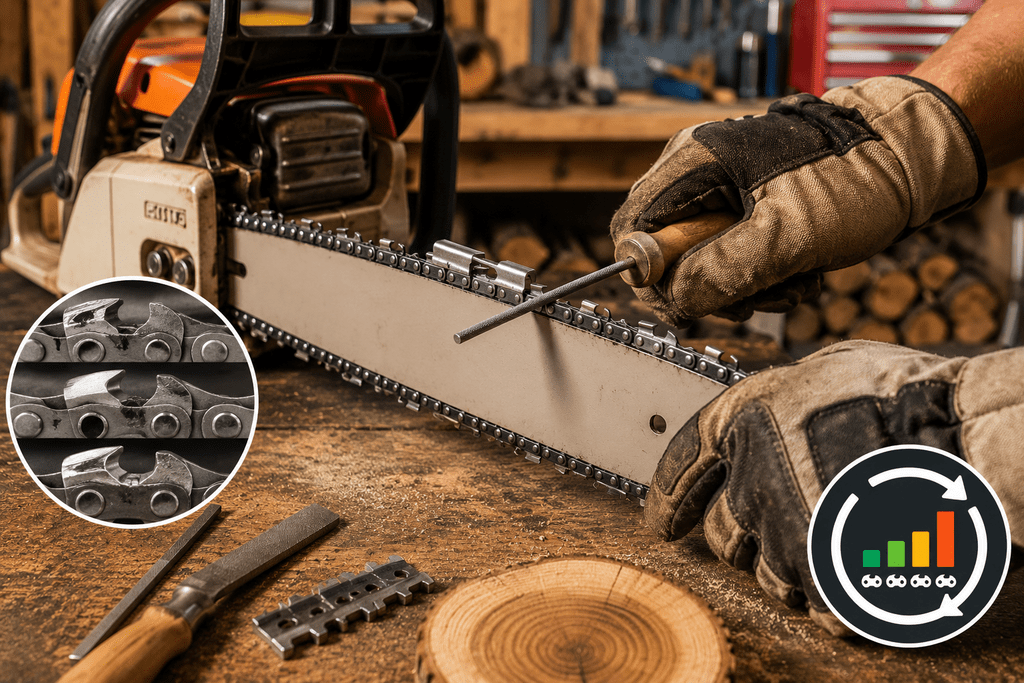
Chainsaw manufacturers don’t actually specify a number of allowed sharpenings. What they specify is a minimum cutter length — once a cutting tooth is filed down past that point, the chain has reached its service limit, regardless of whether that took eight sharpenings or eighteen.
This is a more useful way to think about the whole question. Instead of counting sharpenings, the real measure of “how much life is left” is how much cutter material remains compared to that minimum spec.
It’s worth internalizing this shift in thinking, since it changes how you approach every future sharpening session. Rather than anxiously counting toward some imagined limit, you can simply check cutter length periodically and know exactly where you stand.
How to Find Your Chain’s Service Limit?
A few ways to check where your specific chain stands:
- Many chains include a wear indicator mark, a small stamped line near the base of each cutter, showing the minimum safe length
- Your chain manufacturer’s specifications list the exact minimum cutter length for your specific chain model
- A quick visual comparison between a well-worn cutter and a brand-new one on the same chain can reveal how much length has already been filed away
If you’re not sure whether your specific chain has a wear indicator, check the manufacturer’s documentation or ask a local chainsaw shop to help you identify it.
What Determines How Many Sharpenings You Actually Get?
A handful of real-world factors explain why sharpening counts vary so much between owners:
- Sharpening technique — consistent, light filing preserves more material over time than heavy, inconsistent filing
- How often you sharpen — more frequent, lighter sessions generally beat infrequent, aggressive ones for total sharpening count
- Damage requiring extra material removal — a chain that regularly hits dirt or rocks needs more aggressive filing to fully restore the edge each time
- Consistency across cutters — uneven filing shortens some cutters faster than others, effectively limiting the whole chain’s remaining life
This is really the core insight: how you sharpen matters more to your total count than any fixed number ever could.
It’s a bit counterintuitive, but the owner who sharpens “too often” by conventional wisdom — catching dullness early and filing lightly — often ends up with more total sharpenings over a chain’s lifetime than the owner who waits until the chain is nearly unusable before each session.
The Raker Connection: Why Depth Gauges Matter Too
Here’s a detail that often gets overlooked. As cutters get shorter from repeated sharpening, the depth gauges (sometimes called rakers) sitting just in front of each cutter need periodic adjustment too, or cutting performance suffers even before you’ve hit the actual service limit.
- Depth gauges control how deeply the cutter bites into the wood with each pass
- As cutters shorten, the relative height of the depth gauge increases, reducing cutting aggressiveness
- Periodically lowering the depth gauges, following manufacturer specifications, keeps cutting performance consistent across the chain’s usable life
Skipping depth gauge maintenance doesn’t shorten your total possible sharpening count, but it does mean the chain performs poorly well before it’s actually reached its true service limit — which can trick you into thinking it’s worn out sooner than it really is.
Signs You’ve Reached the End
A few clear indicators tell you a chain has genuinely run out of sharpenings:
- Cutters have reached or passed the manufacturer’s minimum length or wear indicator mark
- The chain no longer holds a usable edge even immediately after a proper sharpening
- Cutters have become noticeably inconsistent in length across the chain
- Performance remains poor even after correcting depth gauge height
Any of these signs mean it’s time to retire the chain, regardless of how many times you’ve technically sharpened it up to that point.
Tips to Maximize the Number of Sharpenings You Get
A few habits genuinely extend how many sharpenings you’ll get out of a chain:
- Sharpen sooner, before the chain gets fully dull, so each session removes less material
- Use consistent filing angle and pressure across every cutter
- Avoid contact with dirt, rocks, and other contaminants that force more aggressive re-sharpening
- Maintain proper chain tension, since a poorly tensioned chain wears less evenly
- Keep depth gauges properly adjusted so you can judge true performance accurately
None of these guarantee a specific number, but together they stack the odds toward getting meaningfully more life out of every chain you own.
The Bottom Line
How many times can you sharpen a chainsaw blade? Realistically somewhere around 10 to 15 times or more, but that range is really just an average built on wildly different sharpening habits. The true answer isn’t a count at all — it’s how much cutter length remains compared to your chain’s minimum service spec.
Sharpen lightly, sharpen often, and keep those depth gauges maintained, and you’ll likely get more life out of every chain than the average number suggests. Watch cutter length and performance rather than counting sessions, and you’ll know exactly when it’s genuinely time to retire a chain.
The number of sharpenings was never really the point — how much useful cutting life you get out of your chain is. Focus on that, and the count takes care of itself.
Frequently Asked Questions
How many times can you sharpen a chainsaw blade?
Typically 10 to 15 times or more, though the real limit is cutter length, not a fixed sharpening count.
How do I know when a chain has no sharpenings left?
Check for a wear indicator mark or measure cutter length against your manufacturer’s minimum service spec.
Does light, frequent sharpening extend a chain’s total life?
Yes. Removing less metal each time generally results in more total sharpenings than infrequent, aggressive filing.
Why does my chain still cut poorly after sharpening?
Depth gauges may need adjusting, since uncorrected rakers reduce cutting performance even on a properly sharpened chain.
Can hitting dirt or rocks reduce how many times I can sharpen my chain?
Yes, since damage from contaminants requires more aggressive filing, removing more material with each sharpening.
Sharpen Smarter, Not Just More Often
Stop counting sharpenings and start watching cutter length instead. Check for a wear indicator on your chain, keep your depth gauges properly maintained, and sharpen lightly and consistently rather than waiting until the chain is fully dull. Do that, and you’ll likely squeeze more genuine life out of every chain than you expected — and know exactly when it’s truly time for a new one.

I’ve spent the past 10+ years working with chainsaws in forestry, landscaping, and firewood preparation. Along the way, I’ve gained certifications in chainsaw operation and safety and built extensive experience with trusted brands like Stihl, Husqvarna, and Oregon. I enjoy sharing my knowledge through step-by-step guides, tool reviews, and safety advice so others can get the most from their chainsaws while staying safe on every job.
Explore Related posts:
 How Long Does a Battery-Powered Chainsaw Last? Runtime & Lifespan Explained
 Are Einhell Chainsaws Any Good? A Comprehensive Review
 Are Ryobi Chainsaws Any Good? Performance, Durability & Buyer’s Guide
 Can Chainsaws Cut Metal? Dangers, Damage & Safer Alternatives Explained
 Does a Chainsaw Need to Warm Up?
 Do Electric Chainsaws Need Oil? Everything You Must Know About Bar & Chain Lubrication
 How Long Of A Chainsaw Do I Need?
 Best Chainsaw for Elderly Users: 5 Safe, Light and Easy-to-Use Picks for Independent Yard Work